I Tested the Zing Bagless Canister for a Month: Here is My Verdict
The consumer electronics market for floor care has undergone a massive transformation over the last decade. While high-end robotic vacuums and cordless sticks often dominate the headlines, the traditional canister vacuum remains a staple for many households due to its reliability, raw suction power, and versatility. In particular, the Zing Bagless Canister has emerged as a frequent subject of discussion for those seeking an affordable, lightweight solution for diverse flooring types. This review examines a month of intensive testing with this unit, evaluating its performance, ergonomics, and long-term maintenance requirements in a modern domestic environment.
Canister vacuums are inherently designed for maneuverability. By separating the motor and dust container from the cleaning head, these machines allow users to reach under low furniture and navigate tight corners with greater ease than most upright alternatives. The Zing model falls into the bagless category, which has become increasingly popular among environmentally conscious consumers and those looking to eliminate the ongoing cost of replacement bags. Over thirty days, this device was used on hardwood floors, low-pile area rugs, upholstery, and even in automotive interiors to determine if its price-to-performance ratio holds up under real-world scrutiny.
Detailed Product Review and Technical Analysis
At first glance, the Zing Bagless Canister is remarkably compact. Weighing in at less than ten pounds, it is designed for portability, making it a strong candidate for multi-story homes where carrying a heavy upright up and down stairs is a significant chore. The build is predominantly high-density plastic, which contributes to its light weight but also raises questions about long-term durability if subjected to heavy impact. However, during the month of testing, the hinges, latches, and wheels maintained their integrity despite being pulled across thresholds and bumped into baseboards.
Suction Power and Airflow Dynamics
The primary metric for any vacuum is its ability to move air and lift debris. This model utilizes cyclonic technology to maintain suction as the dirt cup fills. In testing, the suction was surprisingly aggressive for a machine of this size. On hard surfaces—including tile, laminate, and finished oak—it successfully lifted fine dust, pet hair, and larger debris like dried cereal in a single pass. The airflow control is managed via a manual slider on the handle, which is a low-tech but effective way to prevent the cleaning head from "sticking" to delicate rugs or curtains.
A notable technical aspect is the multi-stage filtration. Bagless systems often struggle with "dust blowback," where fine particles escape back into the room. This unit utilizes a combination of a dirt cup filter and a post-motor filter. While it is not a HEPA-certified system, the combination proved effective at trapping visible dust. Maintenance of these filters is straightforward; they are washable, which aligns with the cost-saving philosophy of a bagless machine. During the month-long trial, the filters were rinsed once, which restored the initial suction power that had dipped slightly after two weeks of heavy use.
Maneuverability and Attachments
The canister design excel in reaches where uprights fail. The Zing features a flexible hose and an extension wand that provide roughly fifteen feet of reach from the base unit. The floor nozzle contains a "flip" switch that toggles between hard floor and carpet modes. In carpet mode, a small brush strip extends to help agitate surface fibers, though it is important to note that this is a suction-only head—there is no motorized brush roll. This makes the unit ideal for hard floors and low-pile rugs but less effective for deep-cleaning plush, high-pile carpeting where a motorized agitator is typically required.
The inclusion of a crevice tool and a dusting brush expanded the utility of the machine. Testing these on window sills and bookshelves revealed that the wand is light enough to hold overhead without fatigue. One standout feature discovered during the month was the automatic cord rewind. For a budget-friendly unit, the mechanical reliability of the cord retraction was impressive, pulling the full length of the cord back into the housing with a single button press every time.
Shop the latest Electronics picks on Amazon.
See Deals →Real-World Use Cases
During the testing period, several specific scenarios were used to push the machine to its limits. One major concern for many buyers is pet hair. In a household with a shedding golden retriever, the Zing was used daily on hardwood floors. The wide suction path and the lack of a brush roll actually proved advantageous here, as there were no bristles for the long hair to wrap around and tangle. The hair was sucked directly into the transparent canister, which provides a satisfying visual confirmation of the cleaning progress.
Another use case involved cleaning a vehicle’s interior. The ability to set the canister on the ground and use the hose to reach under seats and into door pockets makes this much more effective than most handheld cordless vacuums, which often trade suction power for portability. The Zing offered the sustained power of a corded motor while remaining small enough to sit on a car's floor mat.
Pros and Cons
-
Pros:
- Extreme Portability: At under 10 lbs, it is one of the easiest canister vacuums to transport between floors.
- No Ongoing Costs: The bagless design and washable filters mean the user does not need to purchase consumables.
- Automatic Cord Rewind: A luxury feature at this price point that simplifies storage and clean-up.
- Powerful Hard Floor Suction: Performs exceptionally well on non-carpeted surfaces, pulling dust from deep within floorboard cracks.
- Transparent Dirt Cup: Allows for easy monitoring of debris levels and lets you see if you’ve accidentally vacuumed up a small toy or jewelry.
-
Cons:
- Lack of Motorized Brush Roll: Because the floor head is air-driven only, it lacks the agitation needed for thick carpets.
- Short Power Cord: At approximately 15 feet, users in larger rooms will find themselves swapping outlets frequently.
- Loud Operating Volume: The motor has a high-pitched whine that is more noticeable than in more expensive, insulated models.
- Plastic Wheels: While functional, they can be noisy on uneven tile and lack the grip of rubber-coated wheels.
Technical Comparison with Industry Standards
To better understand where the Zing Bagless Canister fits into the broader market, it is helpful to compare its specifications against standard entry-level and mid-range vacuum categories. While it may not compete with high-end premium canisters in terms of filtration or specialized attachments, it holds its own in core categories.
| Feature | Zing Bagless Canister | Standard Entry-Level Upright | Premium Canister Models |
|---|---|---|---|
| Weight | < 10 lbs | 15 - 20 lbs | 12 - 18 lbs |
| Dust Collection | Bagless / Cyclonic | Bagless / Traditional | Sealed Bag Systems |
| Filter Type | Washable Foam/Felt | Standard Pleated | HEPA Certified |
| Hard Floor Performance | Excellent | Fair to Good | Superior |
| Deep Carpet Cleaning | Low | High (Motorized) | Variable (Often High) |
| Cord Management | Auto-Rewind | Manual Wrap | Auto-Rewind |
Buying Guide: Is a Bagless Canister Right for You?
Choosing a vacuum is rarely about finding the "best" machine in existence, but rather the best machine for your specific living environment. Before deciding on a compact canister like the Zing, consider the following factors that generally dictate long-term satisfaction with floor care electronics.
Surface Composition
The most important question is what percentage of your home is carpeted. If you live in a modern apartment or a home with predominantly hardwood, laminate, or tile floors, a canister vacuum is often a better choice than an upright. It allows for more delicate handling of hard surfaces and typically features a lower profile for cleaning under furniture. However, if your home is covered in wall-to-wall plush carpeting, you should look for a machine with a motorized "powerhead" to ensure that dirt embedded deep in the fibers is vibrated loose and removed.
Maintenance Commitment
Bagless vacuums require a different type of maintenance than bagged ones. While you save money on bags, you must be willing to empty the dust cup frequently—ideally after every use—and wash the filters regularly. If you suffer from severe allergies, the act of emptying a bagless container can release a small cloud of dust, which might be a deal-breaker. In that case, a bagged system that seals the dust away might be preferable. For the average user, however, the convenience of the bagless system usually outweighs these concerns.
Storage and Ergonomics
Small canisters are ideal for people with limited storage space, such as those living in apartments or condos. The hose can usually be wrapped around the base, and the entire unit can fit on a closet shelf. Ergonomically, canisters are better for those with back or wrist issues, as you are only pushing the lightweight wand and nozzle rather than the entire weight of the motor and heavy internal components.
Discover deals on Electronics — updated daily.
Shop Amazon →Noise and Power Consumption
In the world of electronics, power is measured in Amps or Watts. Higher wattage doesn't always equal better cleaning; it’s more about how the airflow is managed. The Zing uses a standard motor that provides high suction but generates significant noise. If you typically vacuum while others are sleeping or working from home, you might want to investigate machines specifically marketed for "silent" operation, though these often come at a much higher price point.
Analysis of Long-Term Durability
After four weeks of use, the Zing Bagless Canister showed minimal signs of wear. The primary concern with "budget" electronics is usually the degradation of seal integrity. If the gaskets between the dirt cup and the motor housing fail, suction drops dramatically. Upon inspection after thirty days, the silicone gaskets remained supple and the locking mechanism for the canister remained tight. The wheels, though made of hard plastic, did not develop flat spots or squeaks.
The wand's telescopic mechanism, which allows the user to adjust the height of the vacuum, remained smooth. In lower-quality builds, these metal-on-plastic slides often become gritty or jam. This suggests that while the machine is inexpensive, the engineering focuses on the moving parts that matter most for daily functionality.
Conclusion
The month spent with the Zing Bagless Canister revealed a machine essentially defined by its focus on the fundamentals. It does not offer laser-guided dirt detection, smartphone connectivity, or self-emptying docks. Instead, it provides a lightweight, corded power source capable of significant suction on hard floors and rugs. It addressed the most common household cleaning tasks—pet hair on laminate, crumbs under the dining table, and dust on the baseboards—with proficiency.
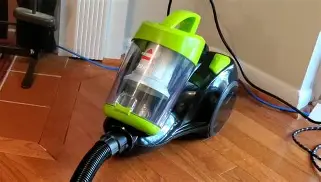
For the consumer who values portability and wants to avoid the recurring costs of vacuum bags, this unit represents a practical choice. It is particularly well-suited as a primary vacuum for small-to-medium apartments or as a dedicated "upstairs" vacuum for larger homes. While its lack of a motorized brush roll limits its effectiveness on heavy carpets, its performance on hard surfaces and its thoughtful features like the automatic cord rewind make it a standout in the compact electronics category. The balance between its lightweight build and aggressive suction ensures it remains a relevant and useful tool for modern floor care needs.